Category: Provenance
-
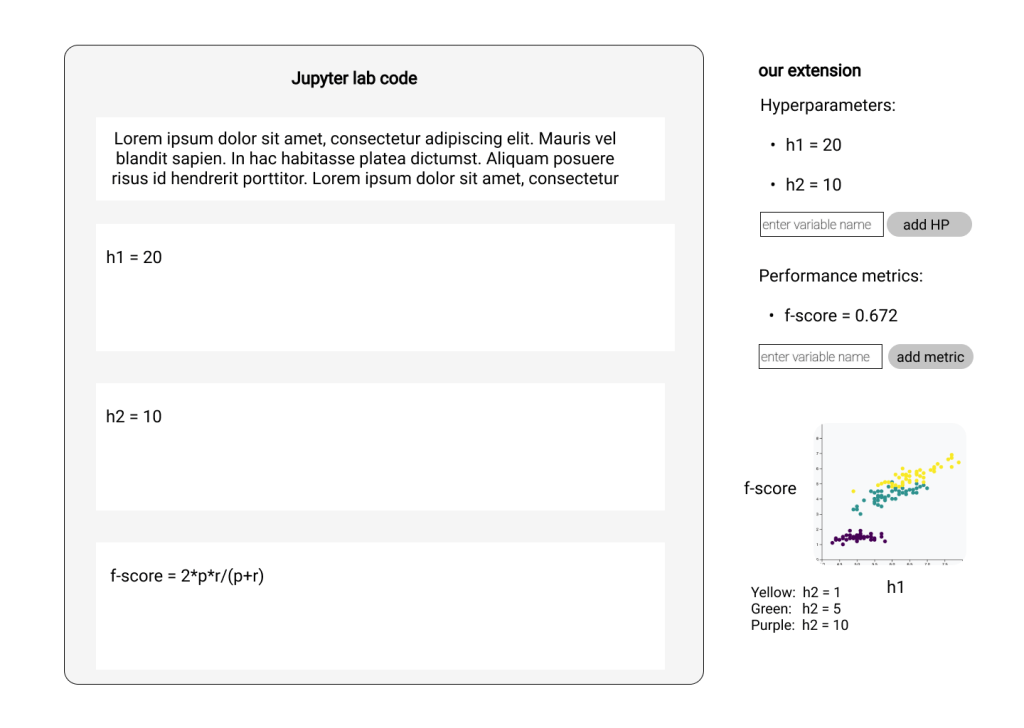
Data Science Provenance
Background While there are some efforts to automate the process of build machine learning model (commonly known as ‘AutoML‘), there are many tasks in the different stages of a data science pipeline (see the diagram below) cannot be fully automated. For example, for ‘Data Wrangling’ a decisions have to be made on which dataset to…
-

1st IEEE Workshop on Visualization and Provenance Across Domains
October 22nd, 2023 at IEEE VIS in Melbourne, Australia https://visxprov.github.io/ Our ambition is to build this into a series of workshops, targeting a different research community outside visualization each year, and eventually create a provenance research network that connects all the relevant communities. For this year, we will target the database community, which is one…
-

Dagstuhl Seminar: Human-Centered Approaches for Provenance in Automated Data Science
Sep 10 – Sep 15, 2023, Dagstuhl, Germany https://www.dagstuhl.de/23372 This Dagstuhl Seminar aims to bring together an interdisciplinary group of researchers and practitioners, spanning Data Science (DS) and Machine Learning (ML), Visualization and Human-Computer Interactions (HCI), and Provenance; to tackle the challenges in automated data science (AutoDS). We specifically focus on ways that methods from…
-
Co-chair for Workshop on Provenance and Visualization (ProvViz) 2021
The workshop is part of the Provenance Week, which is the leading international conference on anything provenance related (theory, application, practice, etc.). As the name indicates, the workshop aims to bring together the provenance and visualisation community. The workshop was initially scheduled for 2020, but rescheduled to 2021 because of covid19. More details on the…
-

Behaviour analytics for defence and security (2019, £80,000)
Funder: Defence Science and Technology Laboratory (Dstl), UK Date: 2019 Funding: £80,000 Partner: MASS Ltd In this project, we use the human-machine teaming approach to design a new visual analytics system that supports kill chain elicitation: The system allows user to mark up text in intelligence reports that may form part of a kill chain;…
-
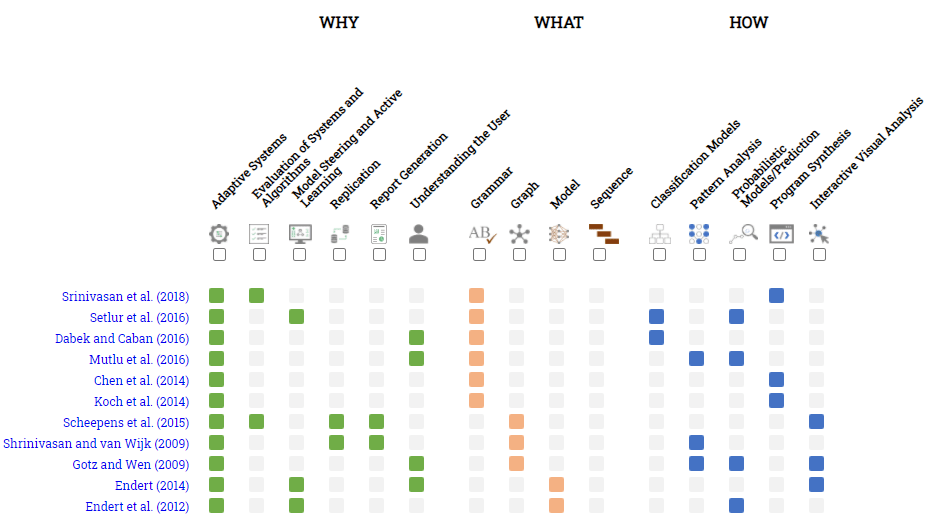
Survey on the Analysis of User Interactions and Visualization Provenance (EuroVis/Computer Graphics Forum)
EuroVis/Computer Graphics Forum 2020 There is fast-growing literature on provenance-related research, covering aspects such as its theoretical framework, use cases, and techniques for capturing, visualizing, and analyzing provenance data. As a result, there is an increasing need to identify and taxonomize the existing scholarship. Such an organization of the research landscape will provide a complete…
-
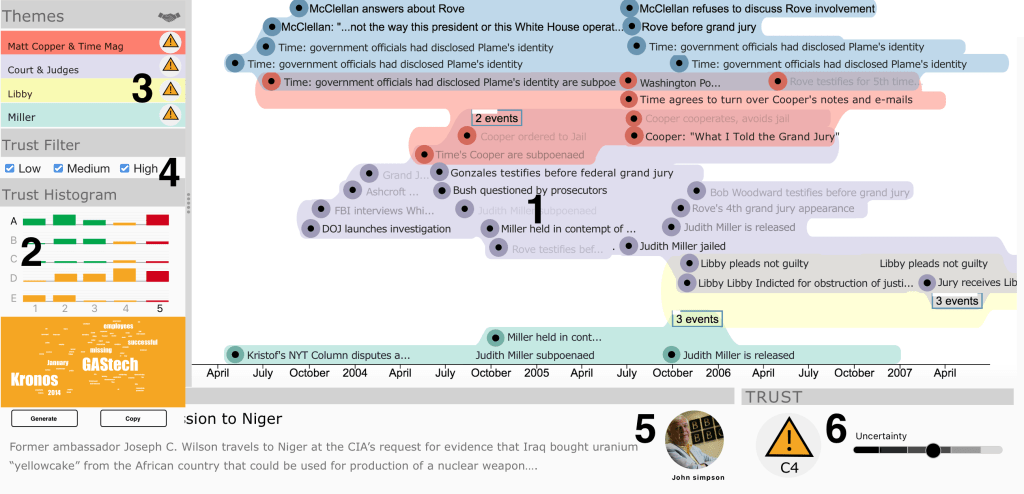
TimeSets: Temporal sensemaking in intelligence analysis (IEEE Computer Graphics and Applications)
IEEE Computer Graphics and Applications (CG&A) 2020 TimeSets is a temporal data visualization technique designed to reveal insights into event sets, such as all the events linked to one person or organization. In this paper we describe two TimeSets-based visual analytics tools for intelligence analysis. In the first case, TimeSets is integrated with other visual…
-

Putting the “i” in interaction: Interactive interfaces personalized to individuals (IEEE Computer Graphics and Applications)
IEEE Computer Graphics and Applications (CG&A) 2020 Interactive data exploration and analysis is an inherently personal process. One’s background, experience, interests, cognitive style, personality, and other sociotechnical factors often shape such a process, as well as the provenance of exploring, analyzing, and interpreting data. This viewpoint posits both what personal information and how such personal…
-
Co-chair for Machine Learning from User Interactions for Visualization and Analytics (MLUI 2020)
I am co-chairing the Machine Learning from User Interactions for Visualization and Analytics (MLUI) workshop this year. It is part of VisWeek 2020, which is the leading international conference on Visualisation (computer graphics, data visualisation, and visual analytics). The workshop is completely online this year, and you can find all the information on its website.
-
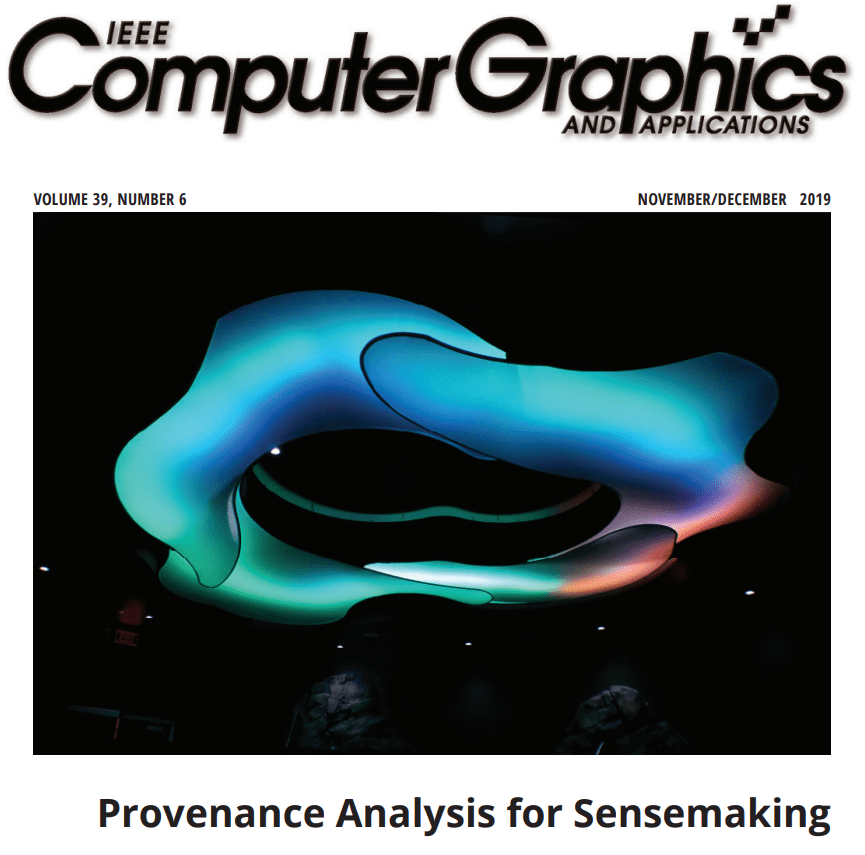
Guest editor for special issue on “Provenance analysis for sensemaking” ( IEEE Computer Graphics and Applications)
This special issue covers research that analyses provenance to better understand how users do sensemaking (information triage, foraging, reasoning, and hypothesis forming and testing). The detailed scope can be found in the Call for Paper. The special issue is now published as part of this issue of IEEE Computer Graphics and Application.
 Human-AI Collaboration