Category: Papers
-
Visualization for epidemiological modelling: challenges, solutions, reflections and recommendations
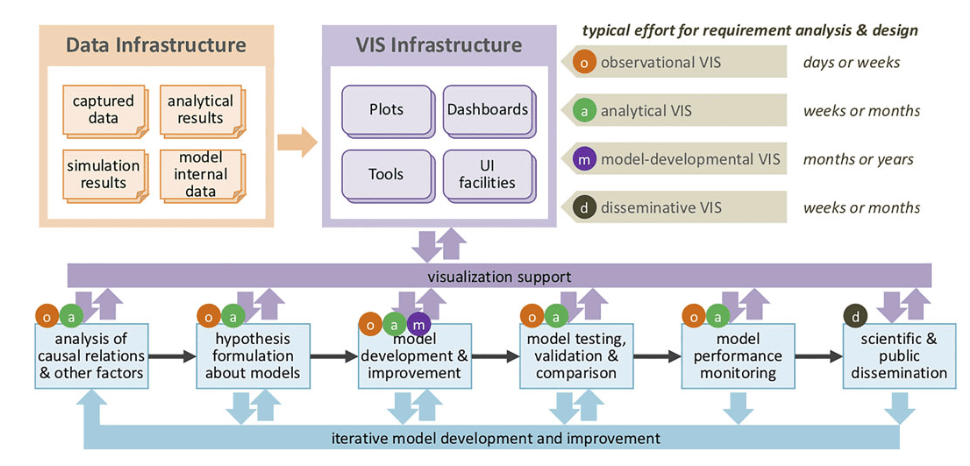
Philosophical Transactions of the Royal Society A: Mathematical, Physical and Engineering Sciences (Impact Factor 5.0) Open access: https://royalsocietypublishing.org/doi/full/10.1098/rsta.2021.0299 We report on an ongoing collaboration between epidemiological modellers and visualization researchers by documenting and reflecting upon knowledge constructs—a series of ideas, approaches and methods taken from existing visualization research and practice—deployed and developed to support modelling…
-
Visual Analytics of Contact Tracing Policy Simulations During an Emergency Response
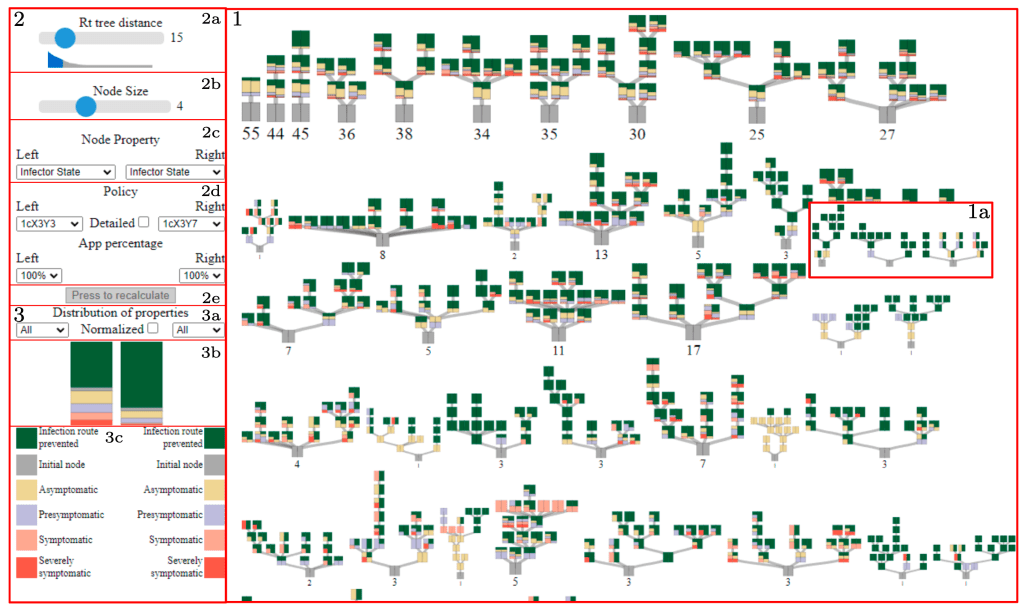
EuroVis 2022 🏆 Best Paper Honorable Mention/ Computer Graphic Forum Open access: https://onlinelibrary.wiley.com/doi/full/10.1111/cgf.14520 Epidemiologists use individual-based models to (a) simulate disease spread over dynamic contact networks and (b) to investi- gate strategies to control the outbreak. These model simulations generate complex ‘infection maps’ of time-varying transmission trees and patterns of spread. Conventional statistical analysis of…
-

Provectories: Embedding-based Analysis of Interaction Provenance Data
IEEE Transaction on Visualisation and Computer Graphics (TVCG) Understanding user behavior patterns and visual analysis strategies is a long-standing challenge. Existing approaches rely largely on time-consuming manual processes such as interviews and the analysis of observational data. While it is technically possible to capture a history of user interactions and application states, it remains difficult…
-
RAMPVIS: Answering the Challenges of Building Visualisation Capabilities for Large-scale Emergency Responses
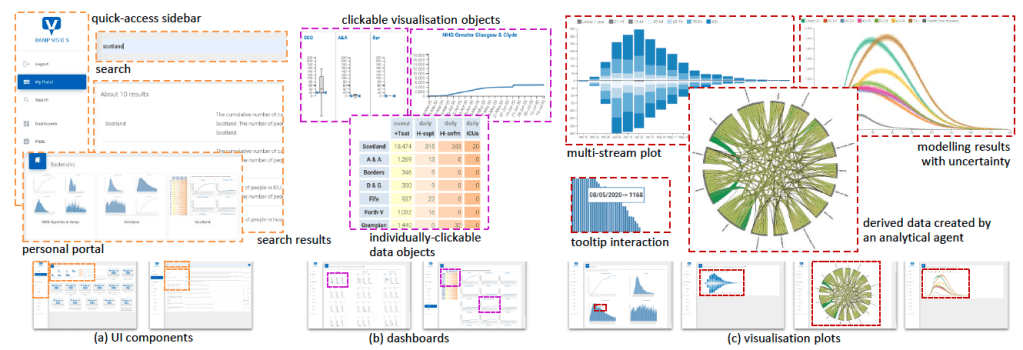
Epidemics (journal) This paper describes the collaborative efforts from the RAMPVIS consortium to help the epidemiologists modelling the various aspects of Covid19, including the spread of the disease and the impact of different isolation policies. Started as a voluntary effort, there are many challenges faced by the group of close to 20 visualisation experts, including…
-
Survey on the Analysis of User Interactions and Visualization Provenance (EuroVis/Computer Graphics Forum)
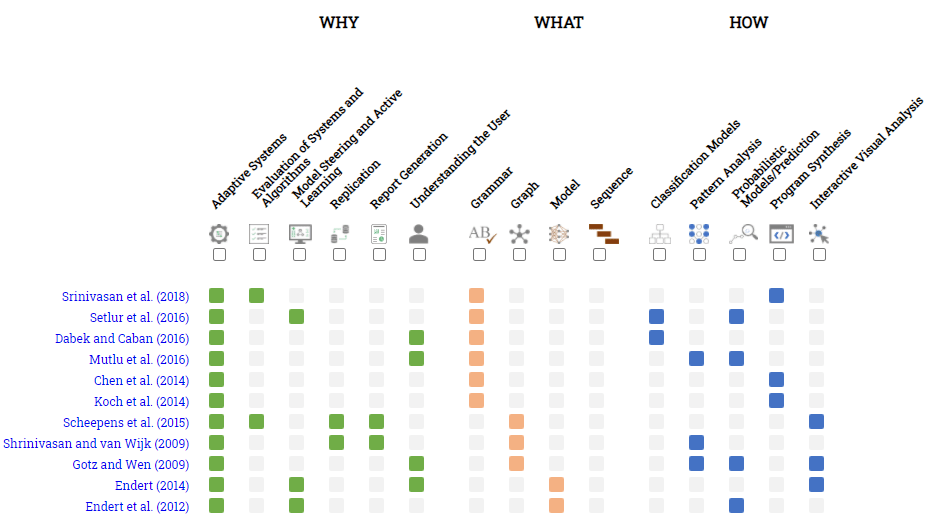
EuroVis/Computer Graphics Forum 2020 There is fast-growing literature on provenance-related research, covering aspects such as its theoretical framework, use cases, and techniques for capturing, visualizing, and analyzing provenance data. As a result, there is an increasing need to identify and taxonomize the existing scholarship. Such an organization of the research landscape will provide a complete…
-
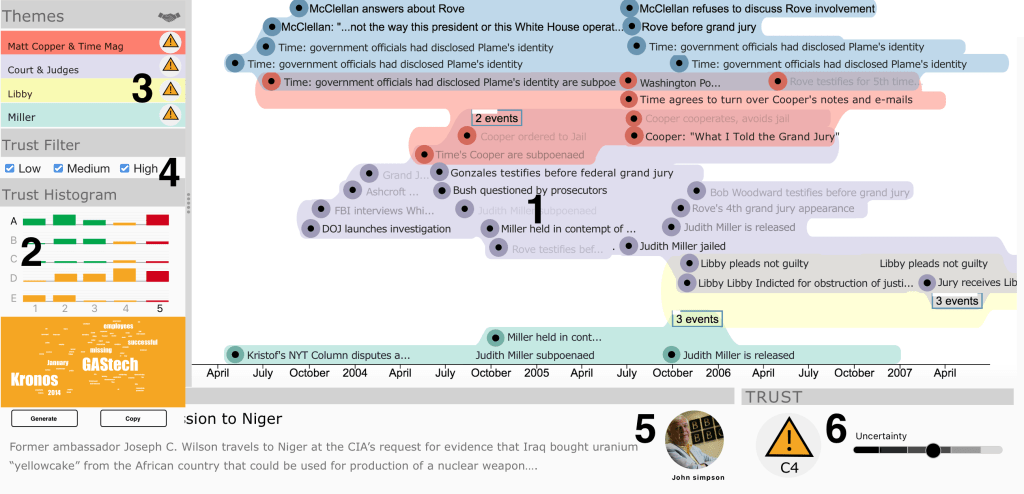
TimeSets: Temporal sensemaking in intelligence analysis (IEEE Computer Graphics and Applications)
IEEE Computer Graphics and Applications (CG&A) 2020 TimeSets is a temporal data visualization technique designed to reveal insights into event sets, such as all the events linked to one person or organization. In this paper we describe two TimeSets-based visual analytics tools for intelligence analysis. In the first case, TimeSets is integrated with other visual…
-

Putting the “i” in interaction: Interactive interfaces personalized to individuals (IEEE Computer Graphics and Applications)
IEEE Computer Graphics and Applications (CG&A) 2020 Interactive data exploration and analysis is an inherently personal process. One’s background, experience, interests, cognitive style, personality, and other sociotechnical factors often shape such a process, as well as the provenance of exploring, analyzing, and interpreting data. This viewpoint posits both what personal information and how such personal…
-
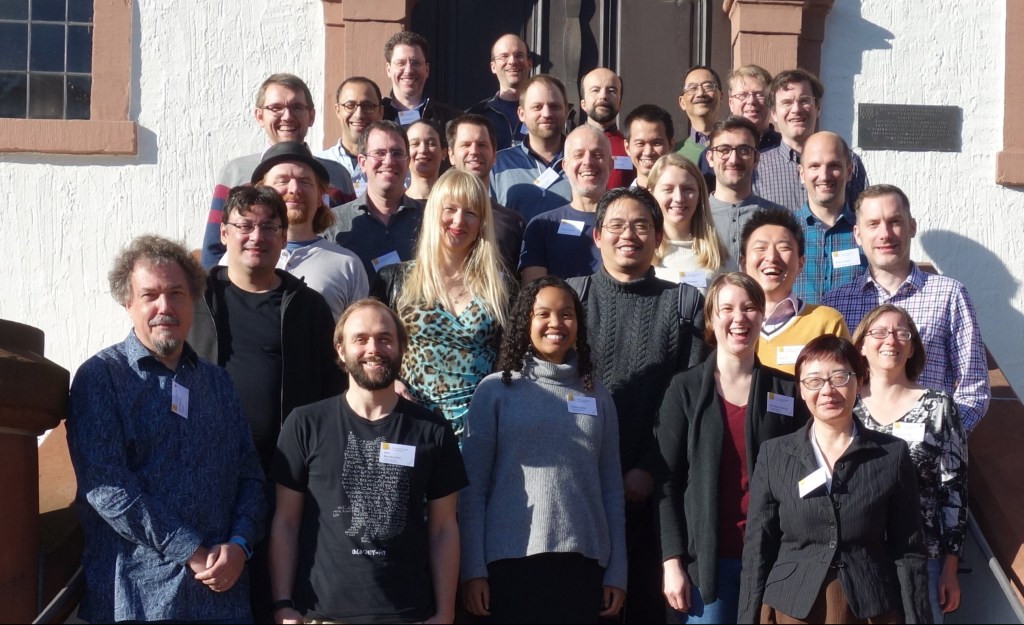
Provenance and logging for sense making (Dagstuhl Reports)
Dagstuhl Reports 2019 This the report for the Dagstuhl Seminar I co-organised. Sense making is one of the biggest challenges in data analysis faced by both the industry and the research community. It involves understanding the data and uncovering its model, generating a hypothesis, selecting analysis methods, creating novel solutions, designing evaluation, and also critical…
-
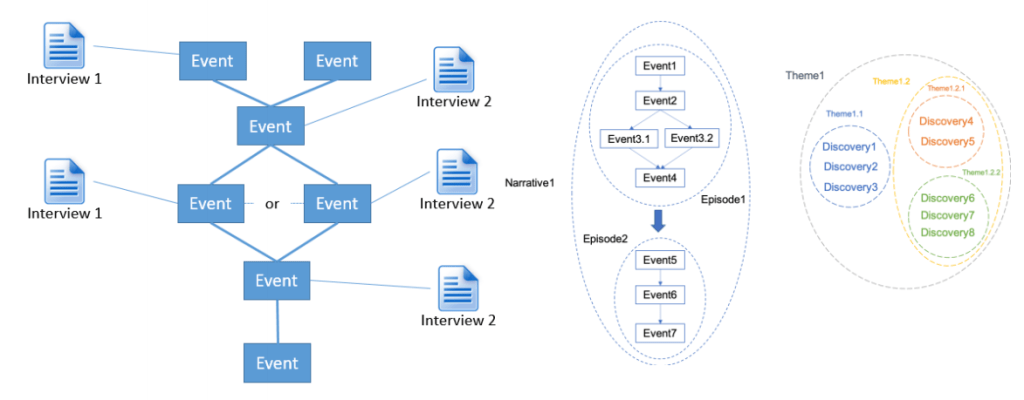
An Approach to Human-Machine Teaming in Legal Investigations Using Anchored Narrative Visualisation and Machine Learning (International Workshop on AI and Intelligent Assistance for Legal Professionals in the Digital Workplace)
The First International Workshop on AI and Intelligent Assistance for Legal Professionals in the Digital Workplace (LegalAIIA 2019) During legal investigations, analysts typically create external representations of an investigated domain as resource for cognitive offloading, reflection and collaboration. For investigations involving very large numbers of documents as evidence, creating such representations can be slow and…
-

Uncertainty of visualizations for SenseMaking in criminal intelligence analysis (EuroVis Workshop on Reproducibility, Verification, and Validation in Visualization)
EuroVis Workshop on Reproducibility, Verification, and Validation in Visualization (EuroRV3) 2018 Uncertainty in visualization is an inevitable issue for sensemaking in criminal intelligence. Accuracy and precision of adoptedvisualization techniques have got greater role in trustworthiness with the system while finding out insights from crime relateddataset. In this paper, we have presented a case study to…
 Human-AI Collaboration