Category: Visual Analytics
-

Human-AI Collaboration – LLM for Qualitative Analysis
The recent breakthrough in Large Language Models (LLMs), such as chatGPT, and generative models, such as Stable Diffusion, can be tremendously valuable in supporting analysis and creative tasks. While powerful, such models can be difficult to use, especially for domain experts, such as qualitative researchers and visual artists, who are not experts in machine learning.…
-

1st IEEE Workshop on Visualization and Provenance Across Domains
October 22nd, 2023 at IEEE VIS in Melbourne, Australia https://visxprov.github.io/ Our ambition is to build this into a series of workshops, targeting a different research community outside visualization each year, and eventually create a provenance research network that connects all the relevant communities. For this year, we will target the database community, which is one…
-

Dagstuhl Seminar: Human-Centered Approaches for Provenance in Automated Data Science
Sep 10 – Sep 15, 2023, Dagstuhl, Germany https://www.dagstuhl.de/23372 This Dagstuhl Seminar aims to bring together an interdisciplinary group of researchers and practitioners, spanning Data Science (DS) and Machine Learning (ML), Visualization and Human-Computer Interactions (HCI), and Provenance; to tackle the challenges in automated data science (AutoDS). We specifically focus on ways that methods from…
-

VizTIG: The Visualization interest group at the Alan Turing Institute
https://www.turing.ac.uk/research/interest-groups/visualization Visualization research and innovation has become critical to data science, it bridges the gap between digital data and human cognition. It is also emerging as an important methodology for helping visualize how machine learning and AI systems arrive at decisions, while clearly illustrating any bias in those decisions. The visualization interest group (VizTIG) meets regularly…
-
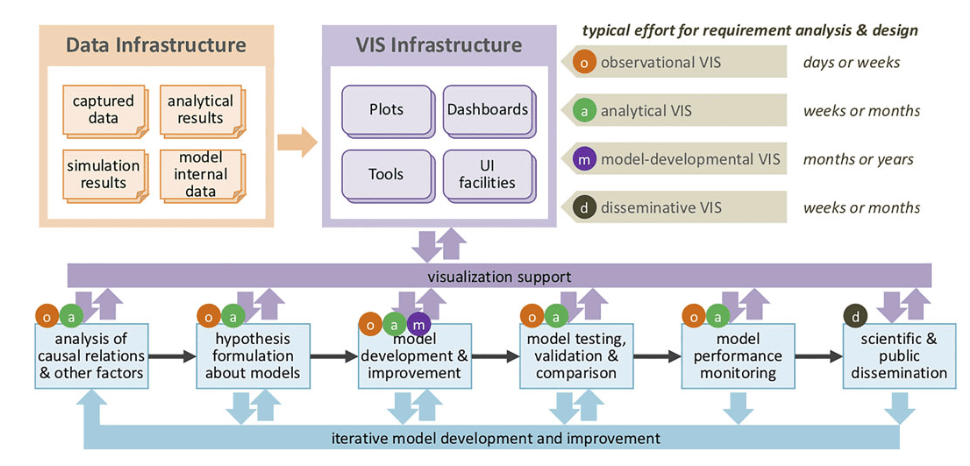
Visualization for epidemiological modelling: challenges, solutions, reflections and recommendations
Philosophical Transactions of the Royal Society A: Mathematical, Physical and Engineering Sciences (Impact Factor 5.0) Open access: https://royalsocietypublishing.org/doi/full/10.1098/rsta.2021.0299 We report on an ongoing collaboration between epidemiological modellers and visualization researchers by documenting and reflecting upon knowledge constructs—a series of ideas, approaches and methods taken from existing visualization research and practice—deployed and developed to support modelling…
-
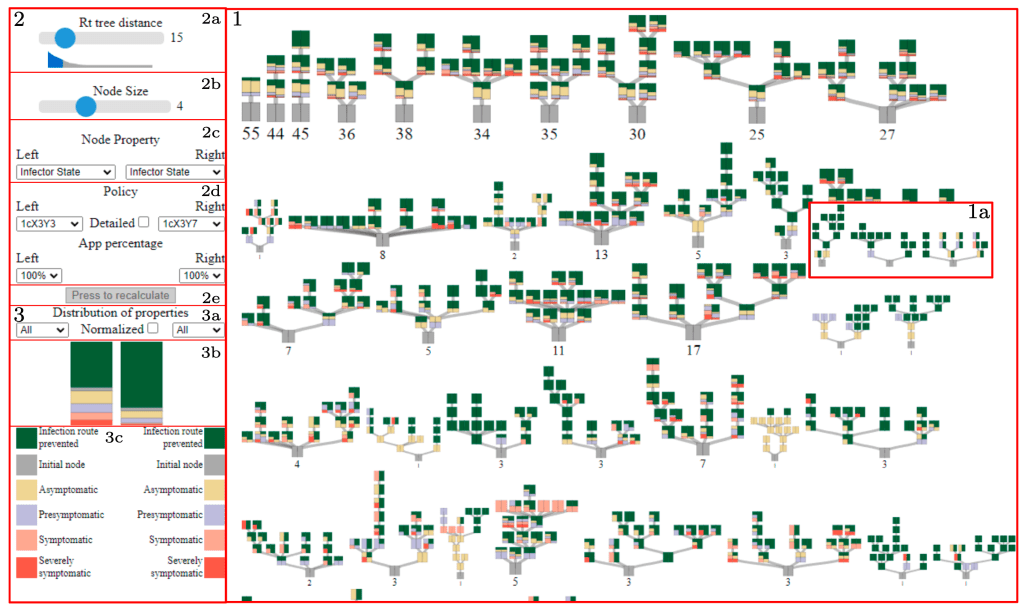
Visual Analytics of Contact Tracing Policy Simulations During an Emergency Response
EuroVis 2022 🏆 Best Paper Honorable Mention/ Computer Graphic Forum Open access: https://onlinelibrary.wiley.com/doi/full/10.1111/cgf.14520 Epidemiologists use individual-based models to (a) simulate disease spread over dynamic contact networks and (b) to investi- gate strategies to control the outbreak. These model simulations generate complex ‘infection maps’ of time-varying transmission trees and patterns of spread. Conventional statistical analysis of…
-

Provectories: Embedding-based Analysis of Interaction Provenance Data
IEEE Transaction on Visualisation and Computer Graphics (TVCG) Understanding user behavior patterns and visual analysis strategies is a long-standing challenge. Existing approaches rely largely on time-consuming manual processes such as interviews and the analysis of observational data. While it is technically possible to capture a history of user interactions and application states, it remains difficult…
-
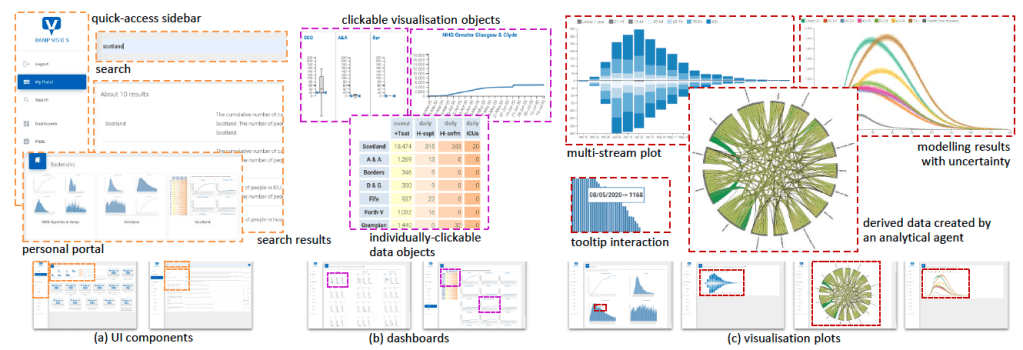
RAMPVIS: Answering the Challenges of Building Visualisation Capabilities for Large-scale Emergency Responses
Epidemics (journal) This paper describes the collaborative efforts from the RAMPVIS consortium to help the epidemiologists modelling the various aspects of Covid19, including the spread of the disease and the impact of different isolation policies. Started as a voluntary effort, there are many challenges faced by the group of close to 20 visualisation experts, including…
-
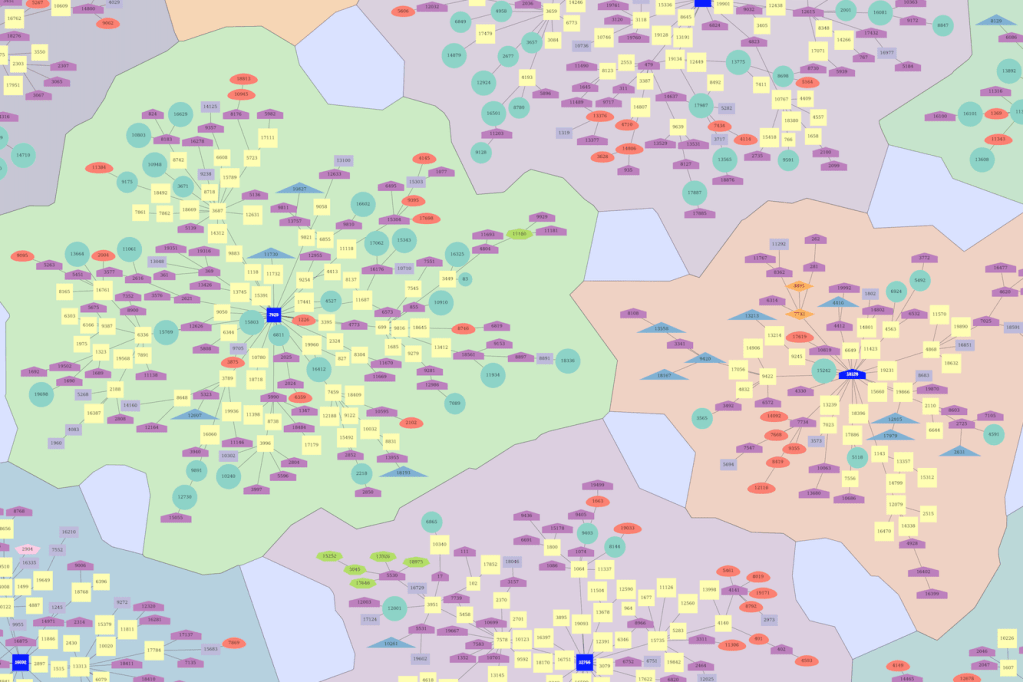
RAMP VIS – Visual Analytics for Covid-19 (2021-2022, £430,000)
EPSRC, 2021-2022, £430,000 This is a collaborative efforts with many visualisation researchers across the UK to provide visual analytics support in the fight against Covid-19. It started as a volunteer effort, led by Prof. Min Chen from Oxford University. A team of 20 visualisation researchers from over 10 different universities worked closely with epidemiologists who…
-
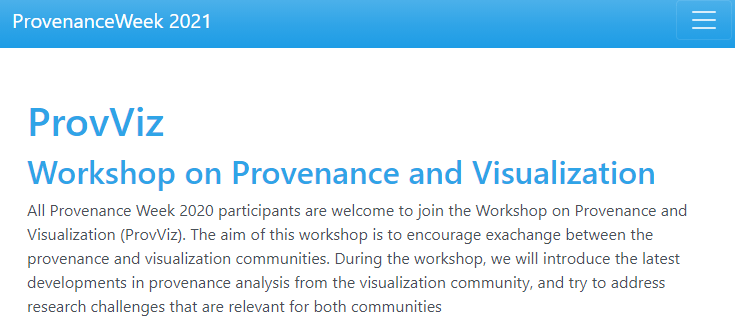
Co-chair for Workshop on Provenance and Visualization (ProvViz) 2021
The workshop is part of the Provenance Week, which is the leading international conference on anything provenance related (theory, application, practice, etc.). As the name indicates, the workshop aims to bring together the provenance and visualisation community. The workshop was initially scheduled for 2020, but rescheduled to 2021 because of covid19. More details on the…
 Human-AI Collaboration